What inspires me
I absolutely adore emergent systems in generative art. Some of my favourite pieces are made with wonderfully considered generative systems that produce jaw-dropping results. During the recent Genuary 2026 prompts, I was particularly taken by the prompt for Genuary 9: Crazy Automaton. Cellular automata hadn't necessarily been something I'd taken a huge interest in before, but digging into it and seeing these beautiful, intricate patterns really opened my eyes to the power of this technique.
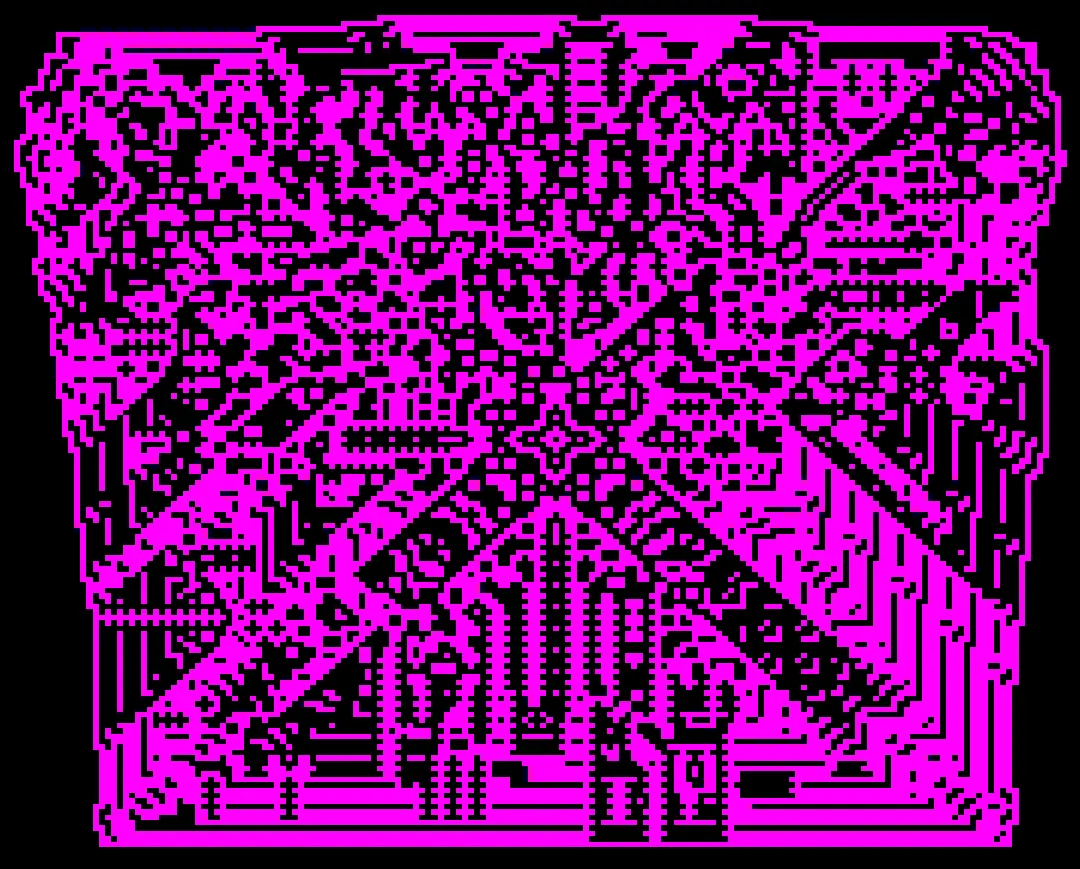
This prompt was an absolute joy to work on and inspired me well beyond the original brief. So much so that I wanted to create a whole series of works and a new technique breaking them down for Fragments.
Cellular automata show up in popular media and in the creative coding community. The recent release Marathon uses CA for a really evocative, haunting atmosphere. Bringing techniques like this into different contexts can elevate your work and help you create something unforgettable:
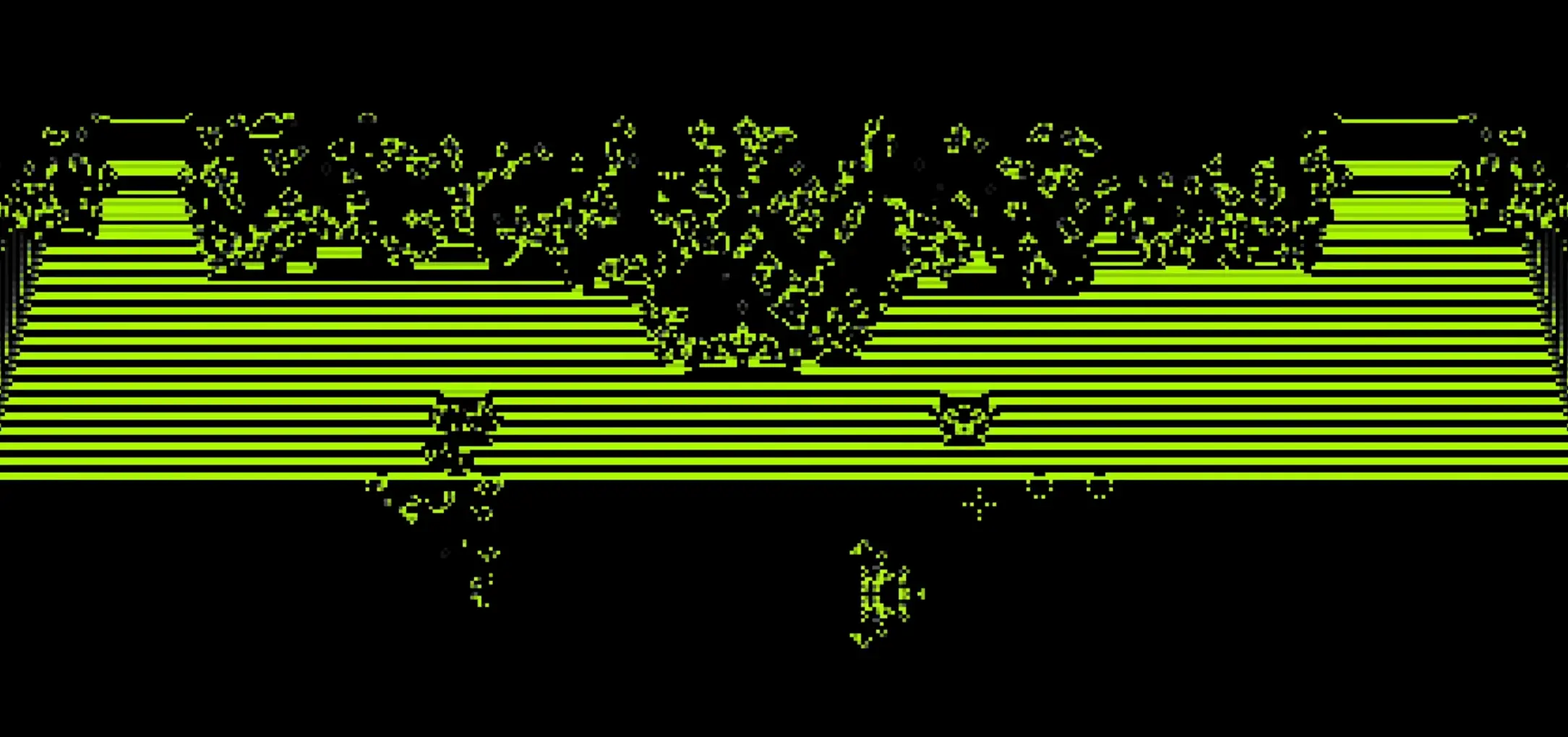
One of my absolute favourite series of art that was created directly from this prompt is AutoGlitch by Jeroen Lam. These are such an amazing example of how you can use simple rules, layered and masked together to create extremely intricate and unique patterns.
In Fragments, the Cellular Automata technique is built from the ground up in TSL with compute shaders. You'll implement two components the same way: first a one-dimensional component, then a two-dimensional one, because both have interesting, divergent outputs and applications.

Dimensionality and Rulesets
The technique covers two distinct dimensions of cellular automata: one-dimensional and two-dimensional. Each has its own rulesets and applications:
- 1D “elementary” (Wolfram) rules - Lovely combinations of patterns and interesting emergent behaviour.
- 2D Moore-neighbour life-like rules - From Conway's Game of Life to more complex rulesets.
Three-dimensional CA systems exist as well, but I wanted to keep the technique focused on these simple compositions and effects.
An advanced technique for creative coders
This technique sits in the Advanced section of Fragments as it gets into some more complex concepts like storage buffers and ping-pong rendering, and heavily utilises compute shaders in TSL.
For the most part, compute shaders are overkill for a small grid, but they scale to very large worlds and still hold a solid frame rate. It's useful to spend more time using them to get a better understanding of how they work so you can apply that knowledge to other techniques like Pixel Sorting and Flow Fields where we are working on potentially much larger data sets.
Beyond running the simulation, the lesson covers compositional experiments such as:
- Seeding tricks (
centre, sparse fills, apex seeds) ruleBandsthat mutate rules midway- Stacked
passesto composite multiple fields
What you’ll unlock in the lesson
The lesson breaks down two real components: WolframCellularAutomata and CellularAutomata. Together they give you full working systems flexible enough for a wide range of effects and compositions:
- Understand storage buffers, ping-pong for 2D
- Neighbourhoods and borders with practical differences between wrap and clamp-to-dead
- Classic references wired as mini-sketches (
RULE_90, Conway, Day and Night, Seeds, stacked Wolfram demos) - Custom
rulesFns, layering, and masking whenruleBands/pass setups need to diverge

Launching in May with the next season of Fragments
The next season of Fragments is almost content-complete and will be launching soon! Everyone on the mailing list will be notified when it's live. Here is the new content that will be launching with the next season:
- A new technique:
Cellular Automata - 4 new shader series:
Emerge,Singularity,Nebula, andPenumbra - 2 new
Basicslessons: focusing on the rich ecosystem of tools available to augment your work - 5 new
Fundamentalslessons: focusing on everything from debugging to performance optimisation using TSL
A new way to learn
With the next season of Fragments, I wanted to give a more affordable entry point to the course for new members. I've created a new Fundamentals membership that will be available alongside the full (Pro) membership. This will give you access to all of the Basics and Fundamentals lessons, as well as a selection of Techniques, Utilities and Shader Breakdowns. As usual, there are no subscriptions or recurring payments - everything you unlock is yours forever!
This is a great way to get started with Fragments and get a feel for the course without committing to the full Pro membership. You can upgrade at any time to the Pro membership, which unlocks everything on the platform.
I'm really excited to share this, and I can't wait to see what you create with it!